Order 21 Tetromino Triptych (July 2024)
^
(With Fania Raczinski) exhibited at Computer Arts Society Members’ Exhibition (2024) BCS, Moorgate, London.
Three order 21 magic squares, visualised with tetrominos coloured by digital root for each number, selected from our magic square application to show the numerical sequences on which the images are based.
This work is part of the CAS permanent collection, also on display at Leicester’s Phoenix Centre café bar from 18 Oct—29 Dec 2024.
Nonlinear Magic (Jan 2024)
^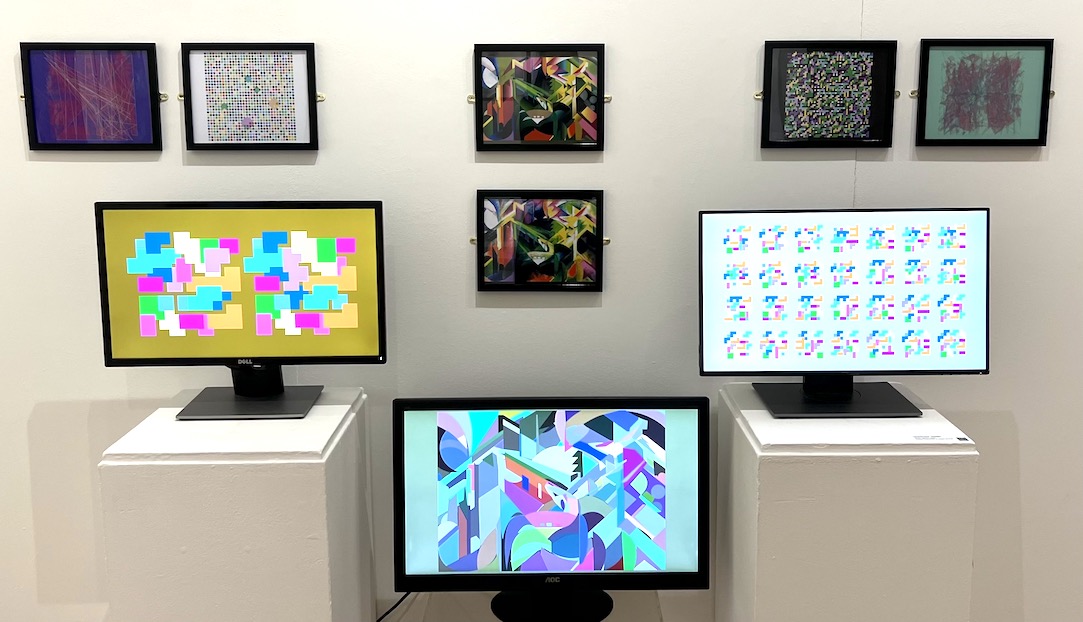
(With Fania Raczinski) exhibited at New Generations (2024) LCB Depot, Leicester.
This is a further development of our magic square application adapted for continual public display.
We now have data for thousands of magic squares and spent four years refining and working on this online combined exhibition/research tool. This is the first time we’ve created prints from digital work, and the first time the online work itself has had a public viewing.
880 (Dec 2019)
^
(With Fania Raczinski) First exhibited at Interact 2019 LCB Depot, Leicester.
Created from the webapp (code on GitHub) and the magic square galleries
Variations on the magic line traced by joining the integers of a magic squares in sequence or other adaptations. (I've been using magic squares since the 1970s but only discovered the late Vera Molnar's work during the research for this!)
Personal Space (2018)
^
(With Fania Raczinski) First exhibited April 2018
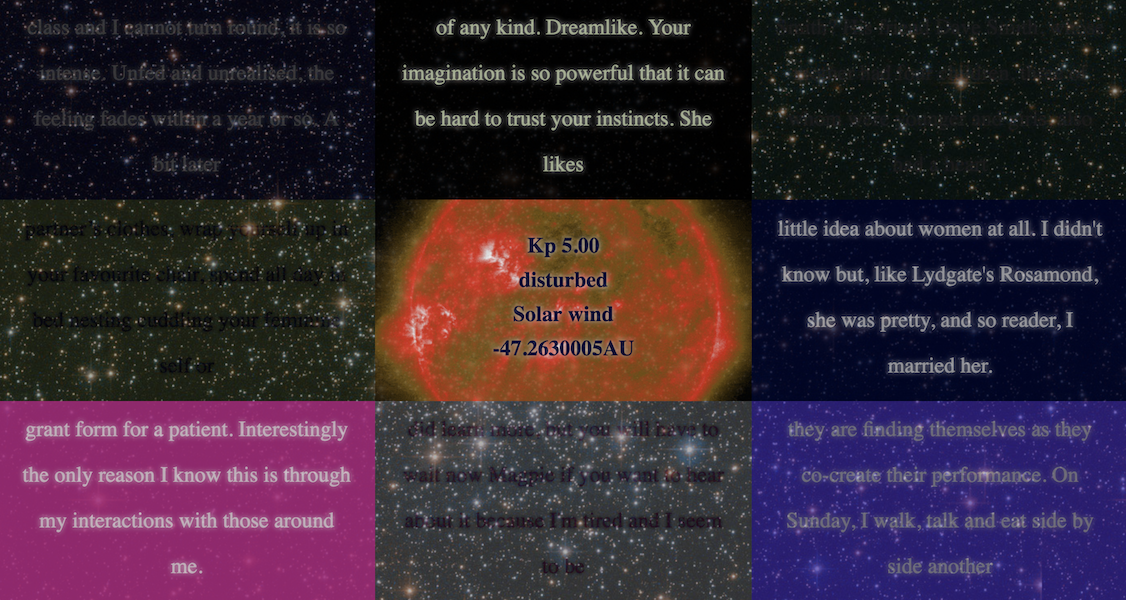
Personal Space online "save to home screen" for mobile.
GitHub Personal Space code
individual diary entries containing words programmatically selected to match the intensity of live space weather data (intensity of geomagnetic activity and extent of solar wind). The text is continually refreshed from over 500 intimate accounts.
Computer Arts Society talk, Leicester 2015
^
(Video by Sean Clark unavailable, see details of event on this archived page)
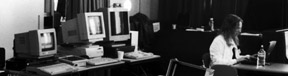
This gave an overview of some recent and current research/experimental threads undertaken while at De Montfort university's IoCT.
This is expanded, together with more documentation about two previous larger participatory works 64 Samples (2000) and Club Confessional (2001) in the updated Explorations in Arts and Technology (2018) (original: 2002 version)—cheaper used versions available—which featured a cover showing the movement-tracking system Mike Quantrill and I set up around 2000.
cubeLife (1998, 2011)
^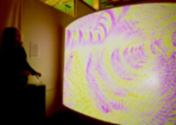
(first exhibited 1999, last exhibited at DMU Cube gallery, Phoenix Square, Leicester UK, 2011)
Captures the collective heartbeats of every participant with mathematical animation and audio for each participant. First exhibited in 1999 at Biomatrix (archived web page). CubeLife is also on the Archive of Digital Art. See stillshot galleries (1999-2011). Read about the background and origins here. CubeLife is part of a larger ongoing project cubelife.org, based on magic squares and cubes.
“through recording an individual's heartbeat on computer then translating it into an image and an object (the artist) has created art which is completely individual to the viewer.” - Artists Newsletter, May 2000
Club Confessional (2001)
^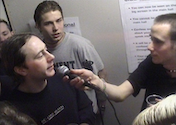
Club Confessional was a commissioned work at The Junction, Cambridge and Pop Centrum 013 in Tilburg, Holland.
A white cube was constructed in the club, inverting the familiar “white cube” gallery space. Inside, instructions encouraged participants to disclose secrets into a microphone. Their mute video was displayed on the dance floor, while their (effectively anonymous) audio was piped elsewhere throughout the club for others to hear. The cube was in constant use each night by participants, who willingly contributed deliberately ephemeral and often very personal accounts. At the Junction (Cambridge) participants tended to enter alone and “confess” with genuine personal stories, while in 013 in Holland participation was much more group-oriented. The re-broadcasted audio and video became the content of the work… created entirely within the white cube. The intention was to highlight the shallowness of anonymity in a “big brother” environment, and to invert (literally) and subvert the preciousness of traditional gallery spaces. This white cube became very “used” by the end of each night…
64 samples (2000)
^
July 25/26, Richard Attenbrough Centre, Leicester, England
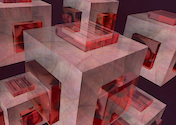
64 samples was the commissioned public participatory digital work involving 64 delegates at the Wired & Dangerous conference (original site dead—see the original leaflet here). Part of a then-new initiative by Arts Council England to investigate the Impact of Technology on the Creative Process
, and the final conference in the Get Wired series.
"An image, audio clip, and some anonymised personal data was taken from 64 delegates to the conference, added to a virtual 3D cube of flesh, then animated live along with remixed sound from their audio clips."
The Emergency Artlab (2000-2002)
^
With Mike Quantrill, Matt Rogalsky (64 Samples) and Pip Greasley, the Emergency Art Lab was formed to deliver rapidly-created performance and participatory/interactive works at specific non-gallery spaces. Art-technology work was created on the spot with live coding to respond to events, and a tongue-in-cheek attitude about the status of art-technology (lab coats). Sites included Leicester and Cambridge in the U.K. and Tilburg in the Netherlands. Club Confessional and 64 Samples were the main outputs, plus Sensor Grid.
Sensor Grid (2001)
^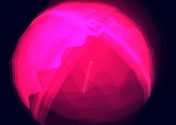
Sensor Grid (2001): Produced during a residency at Loughborough University to create an interactive artwork that tracks human movement, using a custom-built infra-red sensor grid, image and audio.
"The form and light intensity of the projected image reflected accumulative movement through the grid, the image changing as participants moved (or in one case danced) about the space. Five notes from a whole-tone scale sounded as beams were crossed, with two beams triggering an entire tone sequence. During public tests people smiled with pleasure at the effect…"
Biomatrix (1999, archived)
^
A joint exhibition at Loughborough Fine Art Gallery had the first showing of the heartbeat-driven “CubeLife”, with other artists Juliet Robson (now Bryant) and Gillian Hogan. The works concerned digital interaction and accessibility and included “Norman” (Juliet), “XX” (Gillian). With support from the former Gallery of the Future, East Midlands Shape and Loughborough University School of Art. The original website for bioMatrix is archived here.
Digital sketches and small works
^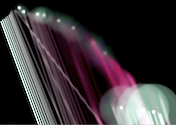
I continually produce experimental code sketches to test an idea or try something in various graphic programming environments, covering a range of technologies over time from the humble animated GIF, though CSS, to Processing and NodeBox. The Java-based Processing works are no longer supported in browsers, others must be downloaded and run on your machine, five are adapted from pre-existing or tutorial code, the rest are original. Cellular Automata (temporary equilibrium between 'ice' and 'fire') runs on GitHub (see code)
Also see other visual work
There is more material (sometimes opening a new window) scattered throughout the site. If you find it, great, but—like the automatic drawing—it's no longer my main focus. For many years and for personal reasons I also maintained a special interest in art and disability, and see my rambling biography for more information.
Coloured Drawing
^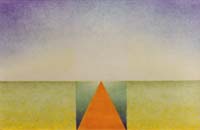
Careful small, detailed icon-like coloured pencil images (I never got on with paint of any kind) taken from found squiggles, fragments of children’s drawings, collected scraps, dreams and interests in geometry and mathematics, with an admixture of post-theosophical, occult and magical symbolism. These were only exhibited once or twice, including one show at Nottingham Castle Gallery. See other visual work.
Automatic Drawing
^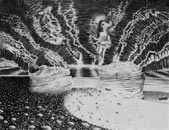
Like the surrealists and spiritualists of the C19. I empty my mind and let the emerging images take over, starting either with a series of random marks, or with some small detail on the page. Drawing in a kind af hypnotic state I find it very hard to talk, sometimes drawing for over four hours and getting through two pencils. If someone is with me, my impression of their presence can appear in the picture. See other visual work.