
introduction (you’re never going to read all this!)
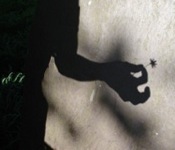 I've been using this personal website as my digital home (here's an old postcard of my real home town) since around 1998; adding to it, leaving work in progress lying around, and rearranging like the rooms in a house. If you read this (and can be bothered) contact me saying what you like or dislike. Feedback might just (and often does) encourage me to update things.
I'm probably a creative generalist (and I'd say an art of any kind is the medium for a creator), mixing special interests and long-term lines of inquiry with artworks, university (paid) and private (err… unpaid) research and freelance work, a process that recursively spawns new directions and ideas.
This site is arranged in three main sections (containing more than first appears) plus this biog, each with it's own coloured links throughout the site. I like the tradition of easter eggs, so some links might not be obvious. Other sections exist only as web peninsulars with maybe a single link from some page or other (like this one), and not much of a way back (you can find the back button :-)
what I do is lightweight glue
These are the people who inhabit the intersections of the Venn diagrams. They believe in ANDs rather than ORs. They're a member of more than one subset, more than one tribe. The reason these people are important is, just like merchants who go between real tribes, they carry ideas from one intellectual tribe to another. I call these people "glue people", because they not only join themselves to a tribe, they join tribes together.
I produce art, music and text (mostly short stories) in an order that varies constantly. I'm a self-taught dabbler in certain areas of mathematics, a doodling programmer, and an information addict with a huge interest span and an almost pathological aversion to specialisation. I've stopped worrying about appearing naïve in any one sphere - focussing on one discipline is admirable but I just can't do it; I'd miss the multi-threaded connections. Other artists working with technology have highlighted this issue of disciplinary homelessness for 30 years or more; the venerable Leonardo magazine is testament to their tenacity.
From 1998-2002 I was a visiting researcher at CCRS with many other artists, and exhibited a heartbeat-driven interactive artwork in 1999. I've delivered seminars on emerging interfaces and their implications for artists/audiences and accessibility, and for some years had a special interest in art-technology and disability, being one of the people turning DisabilityArtsOnline into an independent site under Arts Council England funding and reporting on emerging technology and disability, delivering seminars to various special interest groups. I research techology and culture, and teach under- and post-grad web technologies part-time.
what I'm interested in and I’m doing/have done last decade or so
- visual and digital art
-
- A webapp for analysing and displaying magic squares, for research into mathematical pattern, and artworks
- A webapp personal space combining personal accounts from Alice Tuppen-Corps' amazing collaborative artwork TETTT with live space weather data taken from readings of solar intensity
- A chapter in the 2018 version of Explorations in Art and Technology, a follow-up from the chapter I contributed to the (still rather expensive) 2002 edition - see the review on GoodReads
- Explorative Processing work with Esther Rolinson on her artworks “Splinter” and “Thread”
- A couple of new artworks that strengthen existing collaborations, one with Alice Tuppen-Corps and another around arts evaluation with my wife Fania
- Graphic files of astronomical constellations for stonemasons to make Aidan Shingler's monumental StarDisc sculpture in Derbyshire
- music and literature
-
- A 2017 Memory Wire album "Dervish House" with Jim Tetlow and Chris Conway, and three tracks on a previous live album "Parallel"
- Collecting and curating short instrumental acoustic guitar pieces, some of which were (ab)used in a rather pleasing manner in granular synthesis style on this track
- Working through a large back catalogue of songs, filtering and rewriting
- Maintaining a body of short stories and flash fiction for live readings and publication
- Completing one and finishing two short novels
- Pondering what to do about the unrecorded material from the band I used to sing and write with, who finished after over 23 years of performance in July 2018
- research (papers, essays)
-
There (used to be, but time moves on and no-one ever cares about archiving) a 2011 video of me describing what I do at the IOCT, De Montfort University (UK), where I was a research fellow. I’ll have to find my copy and put it up.
My academic research profile and publications are on Academia.edu
- A new paper on the magic line as mathematical pattern classification for magic square vareties
- A paper and presentation on magic squares as sources of pattern and artwork for Symmetry 2021
- Writing up notes on the cultural history of magic squares as part of a long-term ongoing work with many facets (temporarily suspended for other priorities)
- A co-authored paper and presentation Creative Zombie Apocalypse: A Critique of Computer Creativity Evaluation (full paper here)
- (Now abandoned) sketching out an online system using magic squares to examine how *pattern* might influence *meaning*
- Writing up a basic outline of crucial concepts for the 21st century, partly to counter popular misconceptions and to encourage clearer thinking about ideas that shape culture
- A paper on “cultural anxiety” around the Web 2.0 label (yes, coders, technically, I know it's nonsense and everyone’s now banging on about Web3) published in Media Culture and Society.
- research into visual representations of crowd-sourced tagging (now offline)
- In my previous university role I used to contribute to various events relevant to my interests e.g. Creativity Conversations, and the Knowledge Sharing Synergies Workshop for the Attainable Utopias Open-Design think-tank at Goldsmiths.
- research (projects)
-
- Making and cleaning up a webapp to help with decision-making
- Examining two ways to classify the complexity of magic square pattern sets how they relate, how to reduce their complexity, and writing magic square software with my wife Fania to help in the process.
- Working out how to archive the various projects at the IESD that began March 2013, investigating the use of software for social engagement in energy management and awareness (and building things like this public display, which won the Green ICT category in the EAUC Green Gown Awards)
- (Shelved: original collaborator too busy) a project that aims to track individual movement accurately within sizeable human groups in a defined space at a finer resolution than offered by current GPS. This is an issue in Social Science, and aims to contribute in some small way to the Research Councils UK grand challenge What distinguishes the identities of individuals and groups, and what makes them cohere?
- education, other
-
- After years of re-working how to teach technology skills to successive generations who grew up with mobiles and social media, but may have missed the historical context and craft of programming, specifically front-end web development, creating and managing a module with my wife at a midlands university for this, the moudule is now run by a trusted colleague
- Maintaining a spin-off company to maintain the energy-tracking web app we built for the NUS with EU funding
You can download my artists' statement and Condensed visual portfolio (PDF)
Older freelance work is under the now-redundant Eco Consulting website (download resume) where most of my work was web-based or in book design.
 This site is big, but not clever. Hand-coded in 'emergent' spidery style (no site plan here :-) in mostly valid HTML & CSS (plus archeological early HTML). Like a lot of busy people I neglect my own website. But (as an